Every four years, certain odd traditions happen. The Olympics. Leap Days. Vancouverites attempting to pick their top 10 Council candidates out of 56 randomly sorted names, 20 of whom are for parties that never previously existed.
Yes, it’s true: this October, Vancouver votes.
From Sat Oct 3 to Sat Oct 17, Vancouverites will to pick a Mayor and Council. And, yes, there’s a BC provincial election the week later, so things are even noisier than usual.
Time for another election guide.
Okay, so what’s the story again?
Last election, Sim and his newly-formed center-right ABC party swept into power.
While the voters who showed up clearly supported Sim – all 7 ABC candidates topped the Council votes, and it wasn’t even close – a fragmented opposition turned his win into a landslide. Seemingly-viable progressive parties ran 19 candidates for only 10 council seats, and naturally got their asses handed to them by a united center-right.
Four years later, ABC has gone from promising new party to the folks we can blame for any given issue the city still has. Meanwhile, the main progressive parties are only running 13 candidates across 10 seats. This time, things will be closer.
What are the issues?
You will be shocked to learn that the biggest issues are housing, safety, and affordability.
For context: City government is primarily responsible for our surroundings. Housing approvals (or rejections). Local streets. Water and sewer, parks and libraries, fire and police. You know, the stuff immediately around you.
Is the City in charge of social services? No, that’s the province. How about sparking new world orders? No, that’s the Prime Minister.
Now, some responsibilities awkwardly straddle levels of government. For example, mental health and substance use is nominally a provincial issue, but affects cities acutely. Climate change uncomfortably belongs to no level of government in particular. So, that’s a thing.
But for the most part, Mayor and Council’s 11 equal votes only decide policy and spending at the local-environs level, so that’s where we’ll focus today.
The biggest issues this election are:
- Safety. For some this means cracking down street disorder and policing of drug use. For others it means improving pedestrian and cyclist safety.
- Development. More homes are being completed than in 2022, but with current zoning and construction costs, the city is unlikely to meet its housing completion targets. There is disagreement on how urgent an issue this is.
- Affordability. ABC kept this year’s tax increase for property owners at 0% and home prices have cooled in recent years. But about 55% of Vancouverites are renters, whose costs have continued to climb – and a freeze in new supportive housing units is divisive.
- Infrastructure. Most parties seem to support investment in pools and community centres, but funding and implementation visions differ.
- Ken Sim. He’s been Mayor for 4 years. Whatever problems he hasn’t fixed – even if they’re decades-old – are now top of mind.
Often it’s been helpful to think of Vancouver parties in terms of both traditional left vs. right politics, as well as how they think about city development.
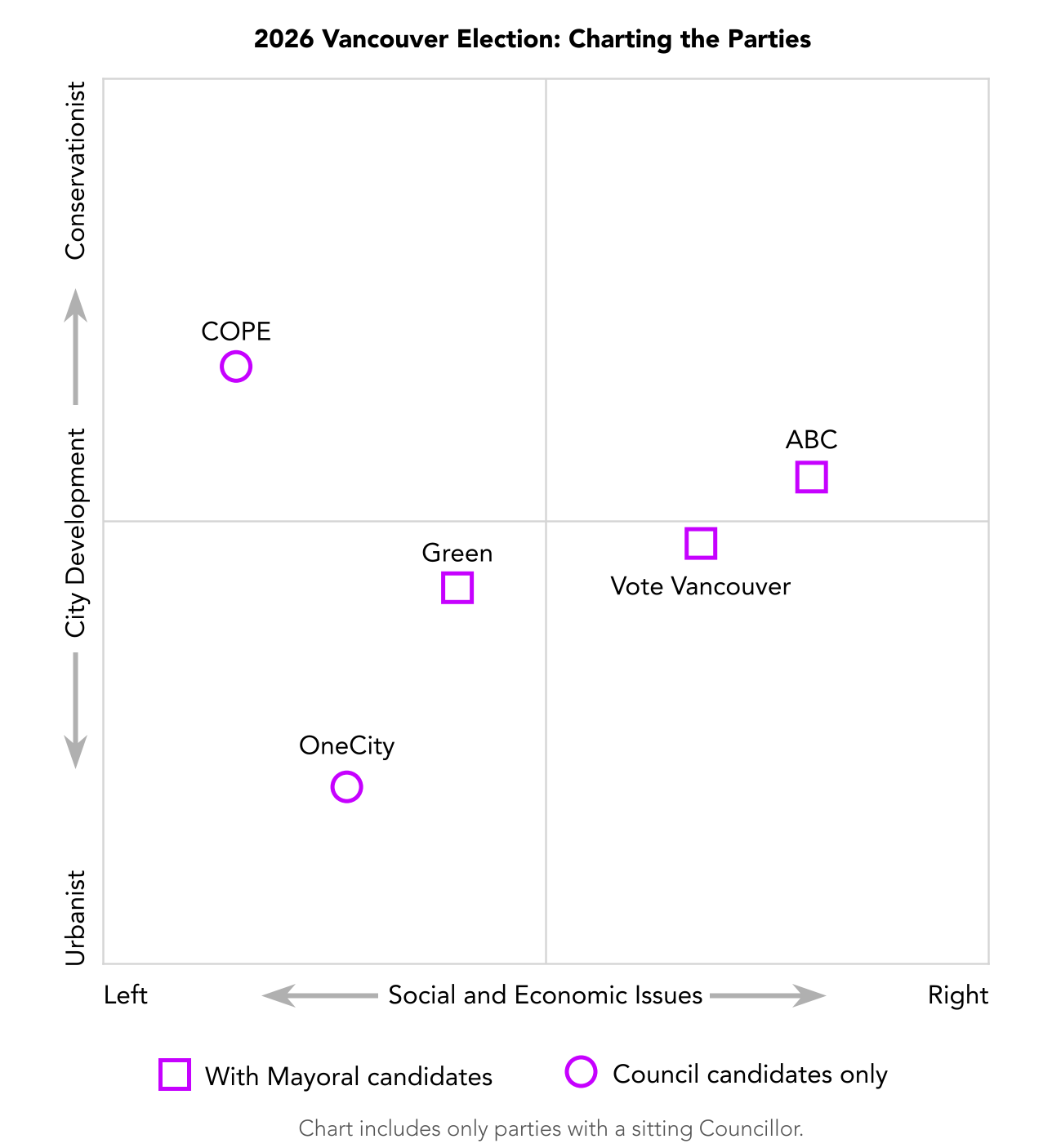
Urbanists generally support a denser, less car-oriented city. This means permitting more homes and shops and helping them actually get built, but also investing in the city’s walking and cycling infrastructure. OneCity is Vancouver’s most prominent urbanist party, but mayoral candidate Pete Fry and his Green party seem to have adopted more urbanist policies over the years, making them natural allies.
Conservationists, by contrast, support protecting existing city character such as street parking, older rental stock, and single-family density. They typically support procedure and consultation to protect tenured residents from change. ABC and COPE have some of these tendencies (albeit mostly conserving different things), with TEAM the undisputed maximal conservationalist party.
Left-wing parties tend to favour progressive social and fiscal policies. At the city level, this might mean supportive housing, prioritizing harm reduction over policing drug use, and prioritizing renters over landowners. OneCity and the Green party are center-left parties, while COPE is very distinctly a leftist party.
Right-wing parties, in the Vancouver context, tend to prioritize law and order and maintaining our famously low property taxes, with more focus on landowners’ rights. Since the governing ABC’s shift slightly more right, they’ve spawned two more-centrist splinter parties (the Vancouver Liberals and Vote Vancouver).
Okay, but what’s the deal with all these parties?
Okay, it’s a lot, but. As far as I can tell, there are about 2 candidates who could win the Mayoralty, and only 4 parties in contention for Council seats. If you like the idea of researching every party and voting with your heart, that’s defensible. Or if you want your Council ballot ticks to avoid the fate of the 34% in 2022 that didn’t even go to a top-20 candidate, you can vote strategically.
Either way, you get one vote for mayor, and 10 for Council. Here’s an outline of each party, with a mind to what makes them different, sorted very roughly from most-incumbent to most-newcomer.
- ABC and Ken Sim
- Green and Pete Fry
- OneCity
- COPE
- Vote Vancouver
- Parties without sitting Councillors
ABC and Ken Sim
After winning a strong majority on Council in 2022, ABC was able to get to work, hiring the promised 100 police officers and cutting permitting times. While the increase in housing starts was closer to 20% than the promised 200%, these combined with approvals that the previous council had made and macroeconomic changes, helping Vancouver’s out-of-control housing prices behave less stupidly than usual during ABC’s term.
The campaign promises ABC did not meet are mostly of the progressive/urbanist type: plant 100,000 trees, hiring 100 mental-health nurses, and adding 5,000 daycare spaces.
Despite mostly doing as he’d said, however, Ken Sim seems relatively unpopular. Without in-depth polling it’s hard to tell why exactly – it could be the cuts he made to hit ABC’s headline 0% tax increase, their freeze on new supportive housing units, cutting the City’s Renters’ Office, or calling Bitcoin “the greatest invention ever in human history” and insisting this was “a hill I’m willing to die on.”
Soon after ABC expelled its Councillor Rebecca Bligh for opposing priorities like re-allowing natural gas heating in new builds, or the supportive housing freeze, ABC suffered a horrific by-election showing. Since then they’ve made some pivots – now Sim seems to talk less about Bitcoin, and more about public safety.
Meanwhile, ABC has earned two splinter parties this election: the Vancouver Liberals led by their former Chief of Staff, and Vote Vancouver led by Bligh. While it’s not clear either has a chance to win seats, they may sap enough ABC votes to cause trouble.
For 2026, ABC’s two signature campaign pledges are to “ban open-air hard drug use”, which is already illegal but certainly might see more police attention, and to lobby the province to establish 100+ involuntary care beds in Vancouver for substance use and mental health disorders. Perhaps hoping to get out the vote, ABC has used their Council majority to add these two campaign promises as non-binding plebiscite questions to the ballot.
Beyond that, ABC’s platform one-pager is easier to digest than other parties, and the three headlines give the vibe: “Public Safety & Addressing Street Disorder”, “Affordability & Accountability at City Hall”, and “Jobs & Economy”. While affordability is a headline, their primary mechanism for delivering this is another 0% tax increase for landowners in 2027.
There are a variety of policy differences between Ken Sim and his challengers, but his message has boiled down to a pretty timeless version of right-wing municipal politics: lower taxes, and get tough on disorder.
For voters who agree with ABC’s own Peter Meiszner, who was recently quoted saying violent crime “was at a 23-year low last year”, this focus on yet more policing may not be compelling. But for those who agree with the wording of the plebiscite that Vancouver now has “unprecedented” levels of “disruption to community safety” may be inspired to back Sim again.
ABC is running a whopping 9 candidates for Council this year: incumbents Lisa Dominato, Sarah Kirby-Yung, Mike Klassen, Peter Meiszner, and Lenny Zhou, joined by new candidates David Grewal, Joyce Gillespie, Lorraine Lowe, and Arezo Zarrabian.
The Vancouver Greens and Pete Fry
Boosted by many years as a city Councillor, Pete Fry of the Green Party won the ad hoc agreement between the three main progressive parties to run a unified Mayor on Sep 8. Once that happened, Fry leapt into the lead. Not only is he the clear forerunner to defeat Ken Sim, Sep 16 polling has him ahead of Sim himself.
The Progressive Trio: Green, OneCity, COPE
While most progressives and urbanists will simply back the Greens’ Fry for Mayor, Fry voters also need to also make 10 Council picks. In many cases, they’ll be picking from amongst the three main progressive parties:
As it happens, these parties’ platforms mostly agree on a lot of issues. They all seek to:
- Civilian responders for non-emergency street disorder
- Restore certain ABC city service cuts
- Reverse the supportive housing freeze, and support more rentals and co-op housing
- Re-establish the renter’s office and increase tenant protections
- Improve access to public washrooms
- Pursue electoral reform (sure would make writing these guides easier)
- Audit the Vancouver Police
- Improve cycling, walking, and bus infrastructure
- Make more investments in pools and community facilities
- Plant more trees
- Secure thousands more affordable homes, including on public land
- Expand childcare
That provides a substantial surface area for a Green/COPE/OneCity coalition to work together and pass policies. But exactly how progressives fill their Council ballots will depend less on whether they broadly support these initiatives, and more on who will:
- Be electable
- Have the best take on these and related issues
- Get ’er done
Okay, back to the Greens
While the 2026 Vancouver Green platform is extremely long, it has some interesting details and signature issues that distinguish them from COPE and OneCity.
On development, they’re distinctly more cautious than “YIMBY” voters might prefer, claiming the 2023 provincial housing targets are “impossible to meet”, proposing “pace of change” measures, and like most of Council they voted against the recent Villages plan (which had turned unpopular despite not being particularly aggressive in terms of upzoning.) Still, the Greens describe the importance of approving more affordable and “missing middle” housing. And their goal of converting 11% of vancouver street surface to community use like parklets and active transit is distinctive and measurable.
On public safety, the Greens propose CROW, a non-police mobile service with a dedicated public phone number for non-emergency street disorder. They also highlight the street safety of drivers, cyclists, and pedestrians – fewer Vancouverites die each year from stranger attacks than they do from traffic collisions1.
While the Vancouver Greens have long had a recognizable brand and relatively popular moderate-left views, they often don’t always get the fired-up candidates and volunteers that fuel winning campaigns. While this may lead to progressive voters giving more picks to COPE or OneCity, the Greens are also liable to pick up votes from centrists that might have voted for ABC or TEAM last election, making the Sep 15 poll showing all 4 Greens in the top 10 a plausible future.
The Green slate for 2026 consists of filmmaker Annette Reilly and renters’ legal advocate Stephanie Smith who have run for Council previously as Greens, joined by former Park Board commissioner and urban farmer Camil Dumont, and hospitality worker Bridget Burns.
OneCity
Since 2018, OneCity has been the most prominent more-housing party in Vancouver.
Compared to other parties, they are more enthusiastic about permitting more homes of all kinds in all neighbourhoods – including supportive housing, co-ops, market rental, condos, low-rise, in-fill, and whatever else it takes to overcome the housing shortage.
While they broadly agree with the other progressive parties, OneCity’s priorities put them to the left of the Greens, and distinctly more urbanist than COPE.
While OneCity does have its own distinctive take, including progressive property taxation (wealthier landowners paying more) and exploring public ownership of the Mobi bike share, their biggest distinction from the other left-leaning parties is their enthusiasm for urban change and improvement.
To pick one small example of how this can play out, the Green platform pledges a moratorium on “micro-suites” – a rule that, since 2014, has allowed homes under 320 sq. ft. to be built in the DTES. OneCity would likely argue that banning tiny suites won’t cause larger homes to be built, simply leading to more people living in their vehicles, shelters, and the streets. The Greens and COPE would likely argue that we should somehow find some other way to fund larger homes for everybody.
All three have the same high-level goal – better and more available housing, a walkable and climate-resilient city – but OneCity has been the most willing to ruffle feathers to get it.
OneCity’s most prominent candidates are sitting councillor and former environmental lawyer Lucy Maloney, who is highly likely to be re-elected, and well-known civic journalist Frances Bula. They are joined by transportation planner Iona Bonamis, who nearly got elected in 2022, as well as lawyer for Indigenous governments Caitlin Stockwell, and Co-op Housing Federation director Jarrett Hagglund.
COPE
Since 1968, COPE has been Vancouver’s most prominent party for renter protections, unions, and good old-fashioned socialism.
While they support the shared progressive policies, they have their own distinctive take. Where OneCity is especially focused on creating new affordable housing, COPE is often most concerned with protecting existing affordable housing. Where NIMBY parties like TEAM generally oppose all development, COPE tends to oppose any development that would disadvantage an existing tenant.
Beyond this core value, the COPE platform is a more leftist and strident take on a progressive agenda for Vancouver. They have specific proposals to raise more revenue from the wealthy: taxing mansions, a land value tax2, and increasing the empty homes tax to 9% – plus taxing empty commercial and industrial property. They also have policy proposals like opening libraries 7 days a week, funding universal breakfast and lunch in Vancouver schools, and a public grocery pilot.
COPE’s current standard-bearer is sitting councillor Sean Orr, who topped the Sep 15 Justason poll in popularity. This election, they are also running transit organizer Solomon Yi-Kieran, climate researcher Devyani Singh, and food-security worker Chloe Leslie.
Vote Vancouver
First elected as Councillor with the NPA in 2018, Rebecca Bligh was first to leave in 2019 after that party’s board took an abrupt rightward swing. She then joined Ken Sim and some of the more moderate NPA Councillors to form ABC Vancouver, which got her re-elected in 2022. Then, apparently, history repeated when Bligh took issue with rightward ABC motions like re-permitting natural gas in new home builds, or freezing new supportive housing, culminating in her being expelled from ABC in 2025.
While it might seem Bligh would be more at home with the Green Party, after her previous conflicts one can hardly blame her for going her own way and forming Vote Vancouver. Unfortunately, so far her mayoral bid and six Council candidates have all polled in the single digits. I’ll update here if there’s indication of a momentum change in Vote Vancouver’s chances this election.
Vancouver Liberals
The Vancouver Liberals are a strange phenomenon. Political strategist Kareem Allam, Ken Sim’s former Chief of Staff, split with ABC acrimoniously in 2023. He then formed his own party and, in a stroke of marketing genius, chose the name “Liberals”. The popularity of the centrist federal Liberals and the past strength of the center-right BC Liberals make this an instantly recognizable brand for an unrelated but roughly centrist party in the City.
What’s more, Allam was able to recruit some notable Council candidates, including former BC Liberal MLA Moira Stilwell, VSB chair Victoria Jung, former NDP campaign manager Jessica Walton, and former NPA Park Board commissioner John Coupar. Allam also posted 10% support in the most recent poll, which is not bad for somebody running a new party who has never held office!
Still, with a totally new party, no sitting Councillors, their Council candidates not having broken the top 20 in the polling, and no indication of a momentum change, all evidence points the Vancouver Liberals being more of a spoiler for ABC than a real contender for 2026.
TEAM, Colleen Hardwick
During her term as NPA Councillor starting in 2018, Colleen Hardwick developed a reputation as a strident opponent of urban development. I mean, supporter of neighbours’ right to veto change in their backyards. When the NPA imploded, she spearheaded a new party, TEAM, to run for Mayor – holding the banner for those who think there is no housing shortage.
Hardwick earned just short of 10% of the mayoral vote that election, but she was undeterred. She ran to get her Council seat back in the 2025 byelection, but hardly got half the votes necessary to win. Since she’s been back on the mayoral ballot for 2026, polling seems to reinforce this picture – she has a small consistent base that does not seem to be expanding.
The TEAM platform is a good example of maximal conservationist thinking: it’s not just about preserving what’s already here, but also undoing the relatively modest zoning and planning reform that has been done in recent years. For example, a key goal is cracking down on multiplexes, which in their view allow too many homes, overly small front yards, and are insufficiently “neighbourly in form”? So, if you’re being terrorized by triplexes, maybe check out TEAM.
The Rest
An uncomfortable reality of Vancouver’s broken electoral system is that there are often so many candidates and parties that they can’t all get real coverage. When you get to new under-the-radar parties like the Muhammad Ahamad’s new center-left Bright Future party or the mostly school-board-only TrueBlue party, there are no polling numbers to even quantify how much of a chance they don’t have of making it this election cycle.
Still! Participating in civic politics is a lot of work. Here’s to everybody who runs, and who put in the effort to try and make their city a better place.
Time to vote!
Since turnout is often low for municipal elections, your vote counts more! Plan your vote, and put a day in your calendar where you’ll have your say. With a BC elections also inbound, voting early is especially appealing this year.
- Advance Voting: Sat Oct 3, Wed Oct 7, Sat Oct 10, Tue Oct 13
- Final Vancouver Election Day: Sat Oct 17, 2026
Go Further
Researching a vote for something so local can be tricky. Here are some starting points for going deeper.
- The City of Vancouver Election Website, including:
- Their Voters’ Guide
- Their Candidate Guide, Mayoral candidates, and Council candidates
- Their Plan Your Vote tool
- Vancouver municipal journalist and local treasure Justin McElroy’s Bluesky feed
- CBC’s This is Vancouver podcast
- Other election guides
- The Tyee’s municipal coverage
- Polling references
- Justason’s Sep 15 mayoral poll data and council poll data
- Research Co.’s July–August poll
- Pallas Data’s July poll
- Jens von Bergmann’s analysis of 2022 ballot patterns
-
In researching this I found a tragic wrinkle in the data: while the the VPD stats do not count it this way, the 11 people murdered by vehicle at the Lapu-Lapu Day festival died both in a traffic collision and a stranger attack. While it’s unclear whether better street safety or public plazas would have mitigated this tragedy, it’s a reminder of how much work we have left to do to build a truly safe society. ↩
-
Fun Fact: While the idea of a land value tax (or perhaps more palatably a land improvements tax exemption) has in recent years been revived as a proposal to discourage land speculation and incentivize land to be put to good use, Vancouver was an early adopter of this policy all the way back in the pre-1914 property boom. Since 1984, BC property taxes have included 100% of the value of any housing built on them, but we’ve maintained the yearly assessment loop necessary to once again experiment with this elegant mechanism. ↩